From SMM to digital marketing: how to grow from one niche into a full-fledged marketer


Many people get into marketing through SMM. You run social media, you know your niche — beauty, education, restaurants or e-commerce — you understand the audience and know how to make content that engages. And then you hit a ceiling: the same tasks, the same salary, and the feeling that you’re “just making posts”.
The good news: an SMM specialist already has half the skills of a digital marketer. You know the audience, you know how to talk to it, and you can see what catches attention. What’s missing is the other half — numbers, channels and the link to sales.
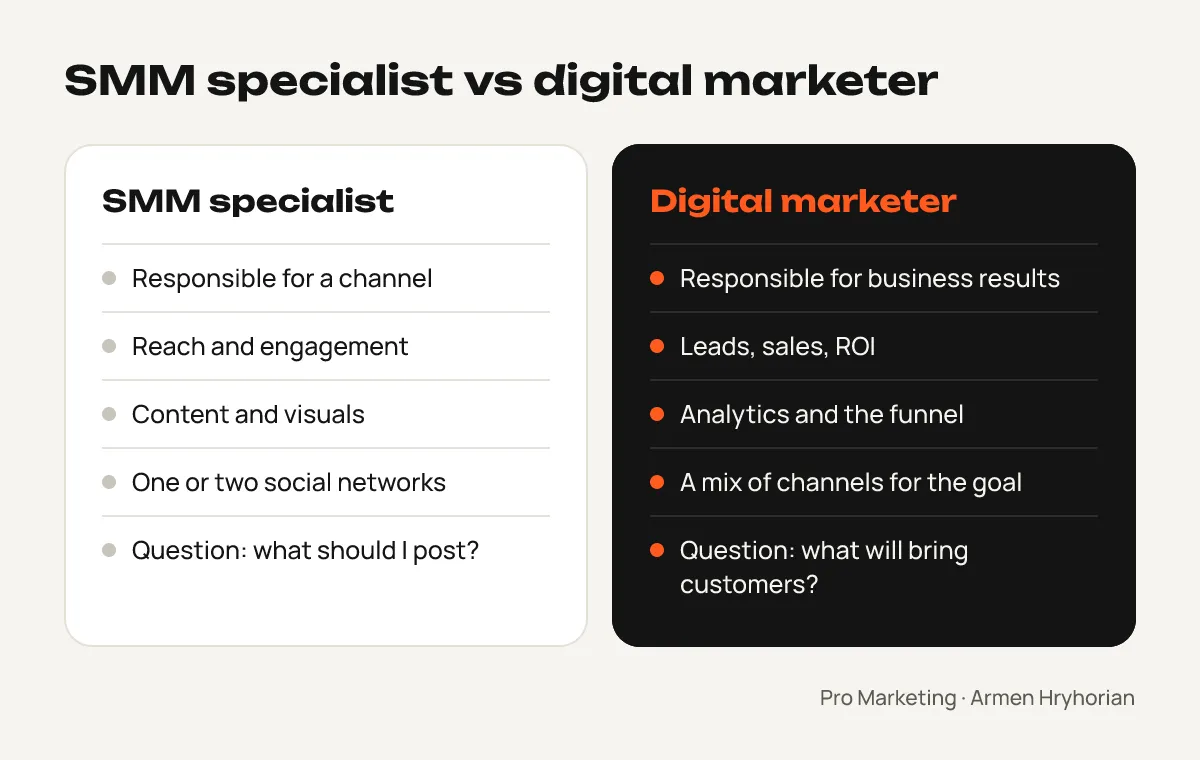
What’s the difference
An SMM specialist is responsible for a channel: content, reach, engagement. A digital marketer is responsible for business results: leads, sales, return on investment. They see the whole customer journey and decide which channels are needed, how much to invest in them and how to tell whether it paid off.
So the switch isn’t about “learning 10 more tools”. It’s about changing the question you ask yourself every day: not “what should I post?” but “what will bring customers, and how much will it cost?”.
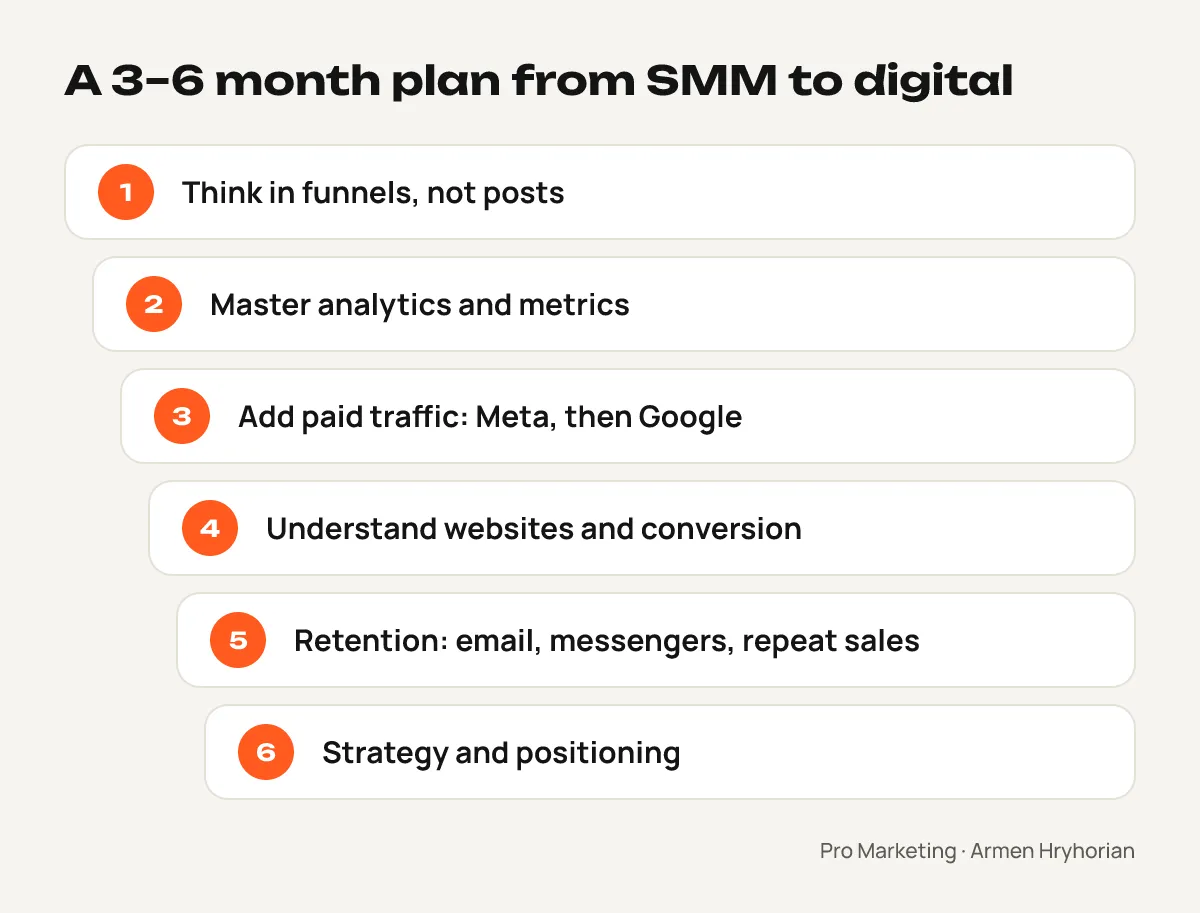
Step 1. Think in funnels, not posts
Understand how a person goes from first contact to purchase: saw it → got interested → submitted a request → bought → came back. Look at your current work from this angle: at which stage do your posts work, and what happens to the person next?
A useful exercise: take your project and draw its funnel with numbers for one month. I wrote about this in detail in the article on the sales funnel.
Step 2. Master analytics
Without numbers you can’t prove your value or make decisions. The minimum worth knowing:
- basic metrics: CTR, CPC, conversion rate, cost per lead, cost per customer, ROMI — see 8 metrics every marketer should know;
- Google Analytics: traffic sources, events, conversions;
- UTM tags — to see which post or campaign brought people in;
- a CRM, or at least a spreadsheet showing what happened to leads next.
Step 3. Add paid traffic — start with Meta
For an SMM specialist, the most natural next step is paid ads on Facebook and Instagram. You already understand the audience and creatives; what’s left is to master the ad account, audience setup, the pixel and conversion optimisation. Then — Google search ads: they teach you to work with demand that already exists.
Step 4. Understand websites and conversion
Ads send people to a website or landing page — where they either submit a request or leave. Learn to evaluate a page through the customer’s eyes: is it clear what’s on offer, are there prices, case studies, reviews, is the form simple, is it easy to use on a phone? Today you can even build a simple landing page without a developer — for example, with AI.
Step 5. Retention: email, messengers, repeat sales
Acquiring a new customer almost always costs more than selling to an existing one again. Email campaigns, chatbots, message sequences and loyalty programmes are tools usually missing from SMM, but they have a big impact on profit.
Step 6. Strategy and positioning
The highest level is being able to answer the owner’s questions: who are we selling to, how are we different from competitors, which channels should we choose and how much money should we put into them. This is where competitor analysis, customer personas and media planning come in.
Your superpower is your niche
Don’t throw away your niche experience. A marketer who deeply understands beauty, education or e-commerce is worth more than a generalist with the same skills: they find insights faster, speak the customers’ language and know what no longer works. So the shortest path is to become a digital marketer in your niche, and expand later.
Narrow expertise + broad skills = a marketer people want to hire.
How to show the switch in your CV and portfolio
- Take 1–2 projects and bring them to numbers: not “ran Instagram”, but “brought in 120 leads at $3 each from ads and content”.
- Run a small campaign with a small budget of your own or for a friend’s business — that’s real experience.
- Describe the case using this structure: task → what was done → result in numbers → conclusions.
- Change your positioning in your profile: not “SMM manager” but “digital marketer in the ___ niche”.
Common mistakes
- Learning everything at once. SEO, email, Google Ads and TikTok courses in parallel — and no results. Go step by step.
- Theory without practice. Apply every new skill to a real project right away.
- Ignoring numbers. They’re exactly what separates a marketer from someone who just executes.
- Waiting for permission. Start taking on analytics and ads in your current job — that’s how your manager will notice the switch.
How long it takes
With regular practice — roughly 3–6 months to reach a confident junior/middle digital marketer level. The speed depends on whether you have a real project to practise on and someone who reviews your decisions.
If you want to get through this path faster — with a personal plan, reviews of your real tasks and interview preparation — come to mentoring. And to find out what level you’re at now, take the marketing knowledge test.