The sales funnel: where a business loses customers and how to find it

“Our ads don’t work” is one of the phrases I hear most often from business owners. But once you start digging, it almost always turns out the ads work fine. Customers get lost at another stage: on the website, in lead handling or in the conversation with a sales rep.
To find out exactly where, you need a funnel.
What a funnel is
A funnel is a person’s path from first contact with you to purchase, broken down into stages. At each stage, some people drop out. That’s normal. What isn’t normal is when almost everyone drops out at one stage.
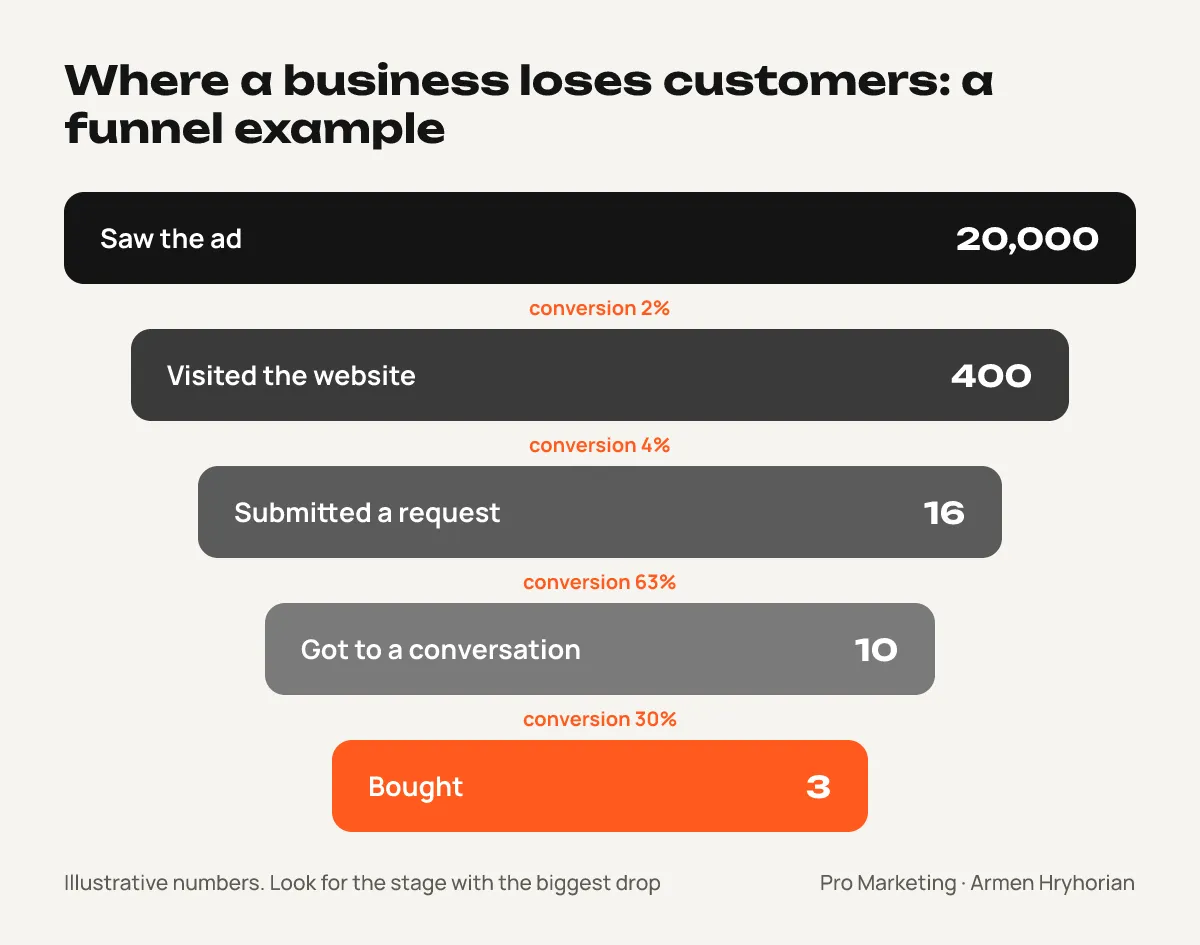
A typical funnel for a business that sells through lead forms:
- Saw the ad — impressions.
- Visited the website — clicks.
- Submitted a request — leads.
- Got to a conversation — a sales rep reached out and the customer answered.
- Bought — sales.
How to find the problem stage
Calculate the conversion rate between every two neighbouring stages: what percentage of people moved on to the next step. Then compare with previous periods or with typical values for your niche.
Look at the example above (the figures are illustrative). A 2% click-through rate and a 4% website conversion rate are perfectly decent for many niches. But then: of 16 leads, only 10 got to a conversation. More than a third of the people who submitted a request themselves never spoke to a sales rep. Increasing the ad budget makes no sense here — first you need to fix lead handling.
Typical failures at each stage
Impressions → clicks. The ad is shown to the wrong audience or doesn’t grab attention. Check targeting, creatives and the offer.
Clicks → leads. The website isn’t convincing: it’s unclear what you offer, there are no prices or reviews, the form is complicated, the site is slow on mobile.
Leads → conversation. Sales reps call back a day later, leads get lost, there’s no CRM. This is one of the most expensive failures, because you’ve already paid for the lead.
Conversation → sale. A weak script, mismatched expectations (the ad promised one thing, the rep offers another), a high price without explaining the value.
The cheapest sales growth doesn’t come from new customers, but from those you’ve already brought in and lost along the way.
What you need to build a funnel
- analytics set up on the website (goals, events);
- a CRM, or at least a spreadsheet where every lead and its status is recorded;
- the habit of looking at the whole funnel, not just the cost per lead.
If it’s hard to put together a funnel for your business, or it’s unclear at which stage customers get lost, that’s exactly what I work through in a marketing audit. And to help your team work with the funnel themselves, there’s team training.