How to train a marketing team so it pays off

Companies regularly spend money on team training: they buy courses, invite speakers, send people to conferences. And a month later everything goes back to how it was — the same processes, the same mistakes, the same results.
The problem isn’t that training doesn’t work. The problem is that it’s often built as an event rather than as a tool for a business goal.
Why training doesn’t deliver results
- A generic programme. A course “about marketing in general” doesn’t take your product, market and goals into account.
- Theory only. People listen and nod — and don’t understand how to apply it tomorrow.
- No goal. No one has defined what should change after the training.
- No measurement. It’s impossible to say whether the investment paid off.
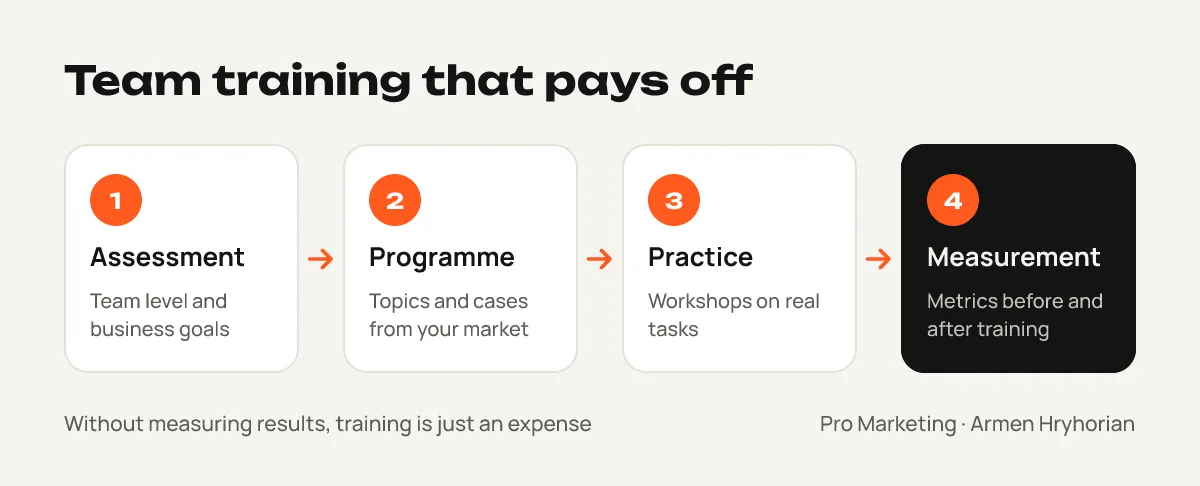
4 steps to training that works
1. Assessment
Before the programme, you need to understand two things: what goals the business faces and what’s stopping the team from reaching them. Sometimes it turns out the problem isn’t knowledge but processes — and then training alone won’t help.
2. A programme built around your business
Topics, examples and assignments come from your reality: your product, your customers, your ad accounts. Then the team doesn’t have to “translate” the knowledge into their work — they work on their own tasks right away.
3. Practice on real tasks
The best training is workshop-based: cover a topic, apply it straight away to a live case, get feedback. After a session like that, the team doesn’t walk away with notes but with a finished result: a plan, hypotheses, an updated funnel.
4. Measurement
Before starting, we agree on the metrics the training should affect: cost per lead, conversion rate, how fast campaigns are launched, the quality of reports. After 1–3 months, we compare. Without this step, training remains an expense rather than an investment.
A good question before any training: “What exactly will the team do differently a month from now?” If there’s no answer, the programme needs rethinking.
Who should be trained in marketing
Not just marketers. Training related teams often has the biggest effect:
- sales — to understand where leads come from and how to work with them;
- product — to speak the same language as marketing;
- managers — to set clear goals for marketing and evaluate results properly.
If you’re planning training for your team, see how I build corporate marketing training. And if you first want to understand exactly what needs improving, start with a marketing audit.